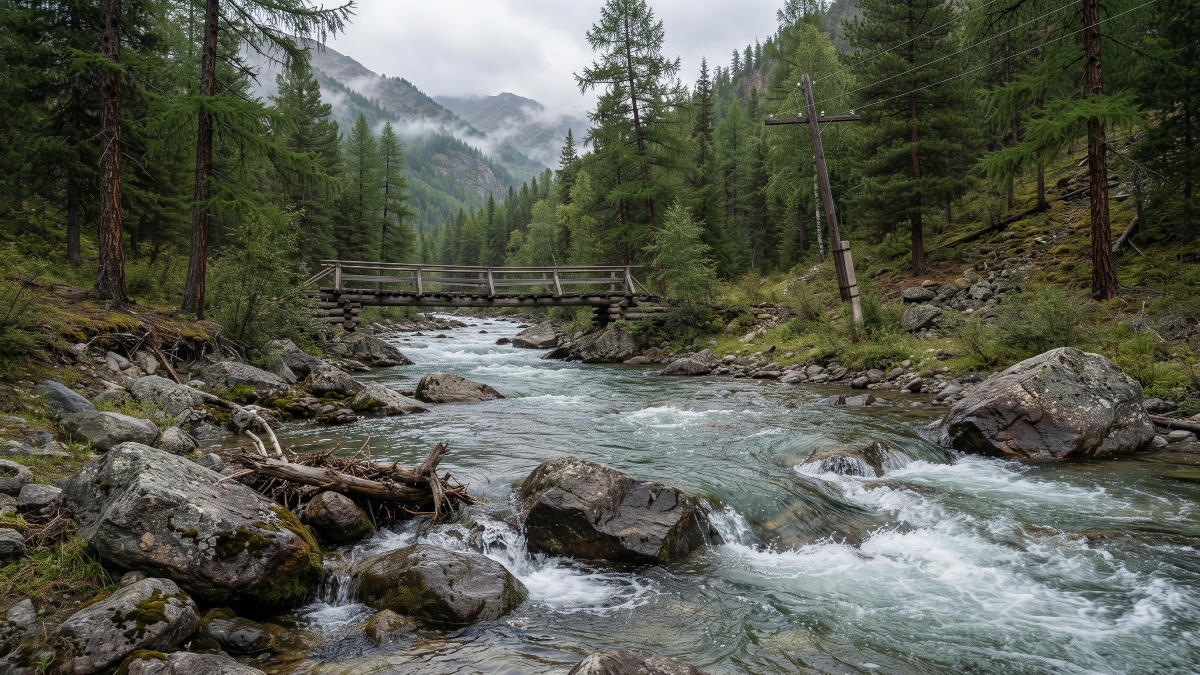
Authorities in East Kazakhstan and private developer Altay Hydro have identified seven mountain rivers for the construction of 11 small hydropower plants with a combined capacity of 170.3 megawatts (MW), though project specifications exist for only one 2.7 MW facility.
According to a response from the regional energy and utilities department to local media outlet inbusiness.kz, the plans are outlined in a memorandum of cooperation between the regional administration and Altay Hydro. Most of the planned capacity is concentrated on three rivers, including two stations totaling 67 MW on the Kara-Koba, three plants totaling 59 MW on the Arasan-Koba, and two facilities totaling 19.6 MW on the Zhaman-Koba. Single plants are also proposed for the Kurty (9.8 MW), Fadikha (9.7 MW), Uryl (2.7 MW), and Shubaragash (2.5 MW) rivers. Officials have not disclosed site coordinates, distances to nearby settlements, construction schedules, or total investment figures.
Only the Uryl river facility has defined terms. At a Sept. 4, 2026, Energy Ministry auction operated by the Kazakhstan Electricity and Power Market Operator (KOREM), Altay Hydro secured the right to build a 2.711 MW plant at a tariff of 41.19 tenge per kilowatt-hour excluding value-added tax. The station is scheduled to enter service before 2031. The auction rate sets the electricity selling price but does not reflect capital construction costs.
Overall investor participation in the national auction was subdued, with four qualified companies submitting bids for a combined 9.711 MW out of 50 MW offered across Kazakhstan. Alongside Altay Hydro, contracts went to Orbulaq Energy for a 3.6 MW project at 41.20 tenge, Kelesgidrostroy for a 2 MW facility at 41.21 tenge, and Evropa Solar for a 1.4 MW unit at 41.23 tenge. Less than 2 percent of the capacity envisaged in the East Kazakhstan memorandum has been confirmed through the auction mechanism.
For the remaining 10 plants in the Katon-Karagay and Markakol districts, the investor must still conduct engineering and environmental surveys to establish construction timelines and determine whether placing two or three stations on a single mountain river is technically and ecologically viable. Public registry records show that Altay Hydro was registered on March 2, 2026, by Altai Aldabergenev and JelSu Energy Ltd., a company founded in Astana on Jan. 8, 2026. Altay Hydro is led by Auez Saduov, who also heads Ust-Kamenogorsk wind company Raduga7 and appears in registration records for Volna 5. Regional authorities have not provided preliminary cost estimates or details on the developer’s financial guarantees.
Despite their recent incorporation, the affiliated companies have announced broader plans across eastern Kazakhstan. In May 2026, JelSu Energy executives, including Chairman Shyngys Kulzhanov and Director Adlet Kenzhebekov, signed a separate memorandum with Abai region Governor Berik Uali to build a three-plant cascade on the Irtysh river (Belokamenskaya, Akzharskaya, and Izvestkovskaya) with a combined capacity of 900 MW. Combined, the newly formed entities have outlined intentions to build more than 1 gigawatt of hydropower capacity in the Irtysh basin and regional mountain rivers.
East Kazakhstan officials say private investment in small hydropower is needed to cover local power deficits without using state budget funds. According to the regional governor’s press service, limited grid capacity in Katon-Karagay and Markakol has held back the construction of recreation centers, visitor centers, and other tourism facilities. Regional Governor Nurymbet Saktaganov has ordered design work for supporting tourism infrastructure, including a pedestrian bridge across the Ak Berel river, and tourism officials noted the plants could eventually host visitors. Both districts lie in the Kazakh Altai mountains along the borders with Russia, China, and Mongolia, and contain the Katon-Karagay National Park and the Markakol Nature Reserve. Until site surveys are completed, it remains unclear how industrial development across seven rivers will be balanced with preserving the natural environment that attracts tourists to the region.