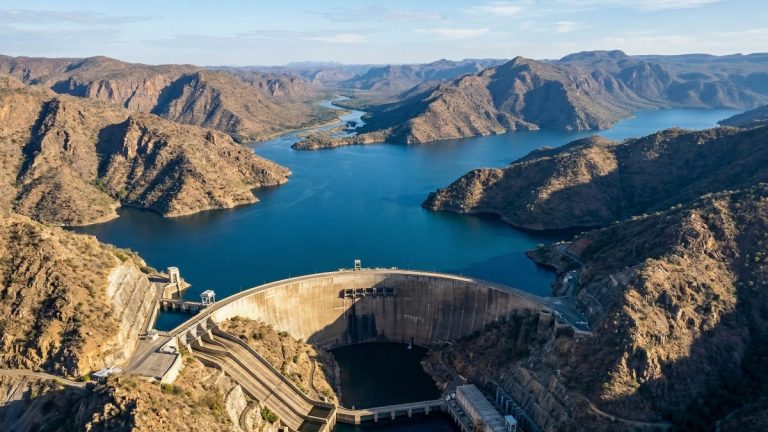
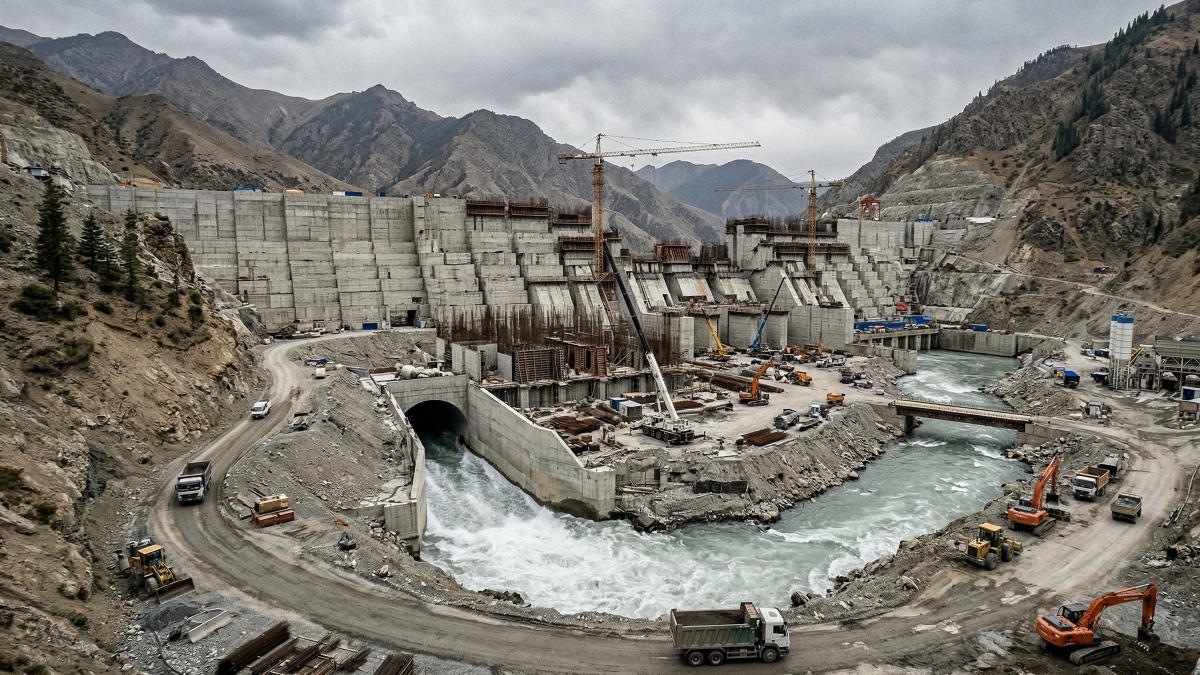
As Tajikistan pushes forward with the towering Rogun dam and Kyrgyzstan seeks international backers for Kambarata-1, Central Asian energy planners face a persistent dilemma. Large hydropower projects promise energy security and low-carbon baseload power for growing economies. They also bring complex transboundary tensions and steep environmental costs. Planners must balance the urgent need for electricity against the reality of shifting hydrological patterns in the Vakhsh and Naryn river basins. A recent article published in Nature Sustainability provides a detailed review of hydropower-related findings in recent academic research and suggests a blueprint for navigating these exact tensions. The researchers outline governance strategies that look beyond pouring new concrete to evaluate entire river systems, hybrid technologies, and modern financing structures.
The review analyzes the global surge of more than 3,700 hydropower dams currently planned or under construction. Many of these projects repeat historical patterns of ecological disruption and social displacement. Researchers argue that modern governance tools can mitigate these impacts if adopted rigorously. Strategic hydropower planning represents a core solution. Instead of evaluating projects one by one, strategic planning assesses the cumulative social and environmental effects of a portfolio of dams across an entire river basin. The authors note that basin-level coordination can maximize energy output while drastically reducing sediment trapping and river fragmentation.
The research also highlights the climate vulnerabilities of traditional large dams. Hydropower expansion often overlooks forecasts of increasing rainfall variability. Droughts directly threaten generation reliability. Furthermore, large reservoirs produce greenhouse gases. Decaying submerged organic matter releases substantial methane emissions, complicating the narrative that dams are entirely carbon-neutral. To counter this, the authors point to hybrid energy solutions. Combining conventional dams with floating solar photovoltaic panels, wind power, and battery storage can stabilize grids with a lower environmental footprint. Covering just ten percent of the world’s hydropower reservoirs with floating solar could add nearly 4,000 gigawatts of new solar capacity.
Funding dynamics have fundamentally shifted over the last two decades. Multilateral institutions like the World Bank no longer monopolize dam financing. Chinese public banks and state-owned enterprises now operate as global leaders in hydropower construction. This fragmented financial environment complicates environmental and social governance. Enforcement frequently defaults to the host country’s regulatory capacity rather than uniform international standards. The International Hydropower Association (IHA) has introduced sustainability assessment tools to bridge this gap, yet actual compliance remains voluntary and unevenly applied across different regions. Worldwide less than 50 IHA assessments have been completed during last decade, the majority of them for already built dams and those under construction.
Although the study heavily references the Amazon, Mekong, and Sub-Saharan Africa, the governance frameworks it outlines apply directly to the post-Soviet space. If planners applied strategic basin planning rigorously to the Amu Darya and Syr Darya basins, regional governments could better manage the inherent trade-offs between upstream winter electricity generation and downstream summer irrigation. For a World Bank or Asian Development Bank specialist evaluating support for Kyrgyzstan’s Kambarata-1, the research underscores the necessity of moving away from isolated impact assessments.
Evaluating Kambarata-1 alongside the existing Toktogul cascade through a unified optimization model could help secure downstream water rights for Uzbekistan and Kazakhstan while maximizing Kyrgyz power exports. The recent trilateral agreement between these three nations to jointly develop Kambarata-1 signals a political willingness for this exact type of cross-border coordination. Applying strategic planning metrics to this joint venture would ensure the project meets rigorous transboundary sustainability standards, reducing the likelihood of future water disputes.
The paper’s emphasis on hybrid technologies also offers a clear pathway for Eurasian energy ministries. Uzbekistan and Kazakhstan are rapidly expanding their solar and wind capacities. Integrating these intermittent sources with existing pumped-storage hydropower or retrofitting Soviet-era reservoirs with floating solar arrays could reduce evaporation in water-scarce regions. Floating solar panels provide a dual benefit. They generate electricity without requiring additional land, and they conserve reservoir water levels against rising regional temperatures. In the Caucasus, where the IHA actively promotes sustainable practices, developers in Georgia could pair existing small run-of-river dams with local solar microgrids to satisfy rural energy demands without damming critical river stretches.
A notable gap in the current literature is the application of these governance frameworks to the rehabilitation of aging legacy infrastructure. The review focuses primarily on the new wave of dam construction in developing nations. Future research needs to address regions like Russia and Ukraine. Planners in these countries face the challenge of retrofitting massive, 20th-century projects on rivers like the Volga or the Dnieper. Understanding how to apply modern environmental justice principles and strategic basin planning to the decommissioning, repair, or modernization of seventy-year-old dams remains an open question for engineers and policy analysts working in Eurasia.
For international donor agencies and regional policymakers, the clear takeaway is that funding and approving standalone dams represents an outdated approach. Maximizing the benefits of hydropower in post-Soviet states now requires mandating basin-wide environmental assessments and actively pairing large dams with “variable” renewable technologies to buffer against an increasingly unpredictable climate.