

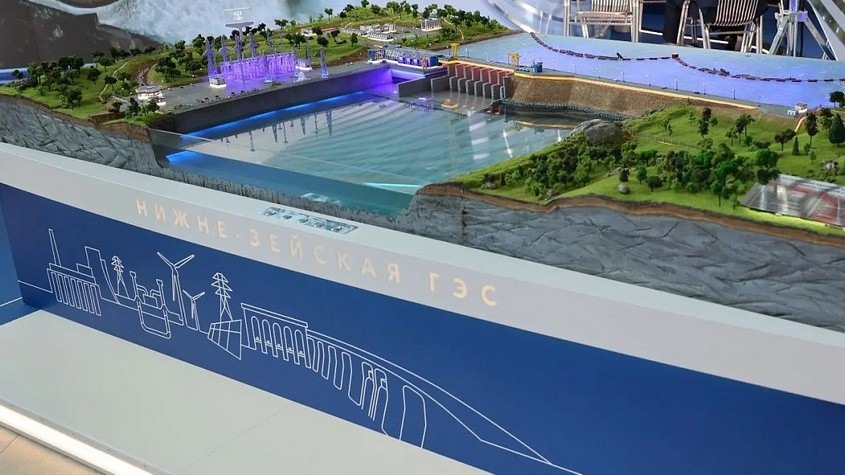
Russian power company RusHydro has presented the design for the 428 MW Lower Zeya hydropower plant in the Amur region, though construction faces delays until at least 2027 due to pending regulatory changes.
The project, presented at the Eastern Economic Forum in Vladivostok, is designed to generate 2.25 billion kilowatt-hours annually. The facility aims to meet growing electricity demand in the Far East power system, provide grid frequency regulation, and manage peak daily consumption loads.
Technical specifications outline an earth-fill dam with an asphalt-concrete diaphragm standing 42.75 meters high, alongside a concrete gravity section and a powerhouse housing four 107 MW Kaplan turbines. The project also includes a spillway capable of discharging more than 24,000 cubic meters of water per second, as well as a reservoir with 1.3 cubic kilometers of flood-control capacity to protect downstream settlements along the Zeya River.
RusHydro First Deputy General Director Nikolai Karpukhin said the submission of design documentation for state expert review will not take place before 2027, pending government decisions on regulatory procedures.
The timeline depends on regulatory amendments that would allow the company to separate plant construction from reservoir preparation into distinct phases, as well as remove requirements for urban planning documentation on flooded lands. The start of physical construction is also tied to government approval of a guaranteed investment return mechanism.
The planned reservoir will span parts of the Mazanovsky, Shimanovsky, Magdagachinsky, and Zeysky districts, along with the closed administrative territory of Tsiolkovsky.